

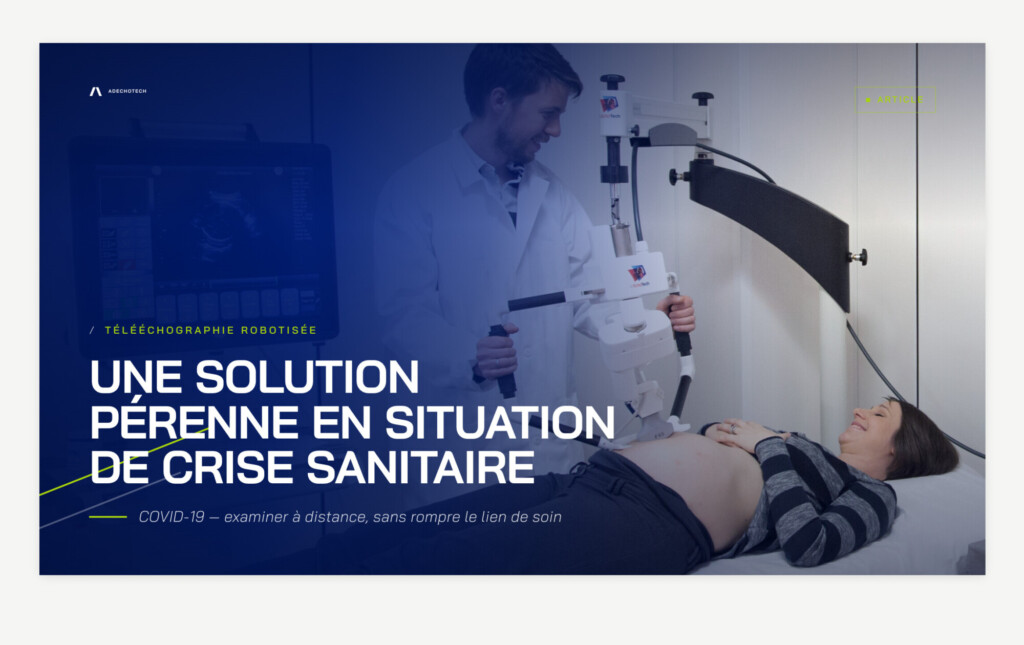
Access to medical imaging is limited in many rural or remote areas. The reason? A shortage of healthcare professionals and logistical challenges. Yet these diagnostic tests play a crucial role in patient care. The COVID-19 pandemic has highlighted these challenges in accessing care. In this context, innovative solutions, such as robotic ultrasound, have emerged to ensure continuity of care and limit the risk of exposure to the virus. In this article, we examine the role of robotic ultrasound during the COVID-19 pandemic, as well as its applications, clinical performance, and prospects for deployment.
Robotic Ultrasound and COVID-19: An Innovation Brought to Light by the Health Crisis
The COVID-19 pandemic has radically transformed healthcare organizations. Indeed, healthcare systems, stretched to their limits, have revealed structural vulnerabilities. Access to imaging exams—and more specifically, ultrasound—has proven critical.
For example, patients living in remote areas often have to travel several hundred kilometers to undergo an exam. Such travel was restricted during the pandemic, leading to an increased risk of diagnostic delays, particularly for prenatal care.
An isolated community in northern Saskatchewan, Canada, found itself deprived of this service due to COVID-19 restrictions. A remote robotic ultrasound system addressed this problem: obstetric exams were performed by a sonographer located more than 600 kilometers away, who controlled the probe in real time. This maintained local access to imaging and avoided potentially risky travel for patients.
Telemedicine Ultrasound: Technology in the Service of Diagnosis
Robotic ultrasound is the result of precise, synchronized remote operation. The MELODY system, developed by AdEchoTech, is a prime example.
A specialist remotely controls a robotic arm—with a probe attached to its end—from a specialized center located far from the patient. The specialist also adjusts the ultrasound machine’s settings. These movements are instantly replicated by a probe-carrying ultrasound robot positioned next to the patient. The specialist:
- maintains control over the movements;
- views the images in real time;
- adjusts the ultrasound machine’s settings.
An on-site assistant, without prior training in ultrasound, handles the robot’s positioning and interacts with the patient. This setup makes it possible to deploy the technology in areas where specialized personnel are limited or unavailable.
Studies show that this remote interaction is seamless. The quality of audio and video communication between the teams was deemed satisfactory in the vast majority of cases, enabling effective coordination between the expert site and the patient site.
Validated Diagnostic Performance of Robotic Telemedicine Ultrasound During the COVID-19 Pandemic
The main issue, beyond technical feasibility, is diagnostic performance. The data show that robotic ultrasound can, in many cases, yield results comparable to those of a conventional examination.
A French multicenter clinical study in children compared the two approaches. It was conducted in patients aged 1 to 10 years and demonstrated a high degree of diagnostic agreement. Pulmonary, cardiac, and abdominal examinations identified similar abnormalities (pulmonary consolidations, pleural effusions, or cardiac abnormalities).
According to a study conducted during a COVID-19 lockdown in an isolated community in Saskatchewan, 81% of targeted obstetric ultrasounds provided images of sufficient diagnostic quality. This made it possible to:
- answer clinical questions such as fetal viability, gestational age, or fetal presentation;
- rapidly guide patient management;
- avoid referral to a specialized center and limit potential exposure to SARS-CoV-2.
These results thus confirm the robustness of tele-ultrasound.
The Benefits of Telemedicine Ultrasound for Patients During a Health Crisis
Studies show a high level of satisfaction and acceptance of robotic ultrasound, reflecting a positive impact on the patient experience.
Patients in isolated communities highlight the following benefits:
- avoiding travel that would otherwise take several hours or even several days;
- reducing transportation costs;
- gaining faster access to a diagnosis.
Robotic tele-ultrasound deployed during the COVID-19 pandemic also helped maintain access to exams and reduce travel and potential exposure to SARS-CoV-2.
The Canadian study reports that nearly all patients surveyed would be willing to repeat the experience. Some testimonials also highlight the importance of being able to remain within one’s community and surrounded by loved ones, especially in situations such as prenatal care.
Nearly half of the parents whose children underwent a robotic ultrasound reported feeling less pressure during the robotic exam compared to a conventional ultrasound. This factor can significantly improve the patient experience, particularly in pediatrics.
A New Organizational Model for Healthcare Using Telemedicine Ultrasound
The COVID-19 pandemic has exposed the limitations of traditional healthcare systems. These vulnerabilities have been particularly pronounced in rural and remote areas, where access to imaging depends on scarce human resources.
This healthcare model has demonstrated several advantages.
- Rapid deployment, with assistants working alongside patients who can be trained in less than an hour, facilitating implementation in areas understaffed with specialized professionals.
- Maintained access to care, with a system that ensures the continuity of diagnostic exams.
- Reduced health risks, such as during the COVID-19 pandemic, when travel and potential exposure to SARS-CoV-2 were limited.
Robotic ultrasound thus plays a role in reducing regional health disparities. Rural populations and Indigenous communities have higher rates of obstetric complications, underscoring the need for easier access to imaging.
Robotic ultrasound illustrates how technological innovation can address public health challenges. It helped maintain access to imaging during the COVID-19 pandemic and has proven its value. It also paves the way for new models of healthcare organization.
Sources :
Adams, Scott J et al. “A Telerobotic Ultrasound Clinic Model of Ultrasound Service Delivery to Improve Access to Imaging in Rural and Remote Communities.” Journal of the American College of Radiology : JACR vol. 19,1 Pt B (2022): 162-171. doi:10.1016/j.jacr.2021.07.023
Delestrain, Celine et al. “Comparison of telerobotic and conventional ultrasonography in children: a crossover bicentric pilot study.” Translational pediatrics vol. 12,5 (2023): 816-826. doi:10.21037/tp-22-569
Adams, Scott J et al. “Telerobotic ultrasound to provide obstetrical ultrasound services remotely during the COVID-19 pandemic.” Journal of telemedicine and telecare vol. 28,8 (2022): 568-576. doi:10.1177/1357633X20965422