

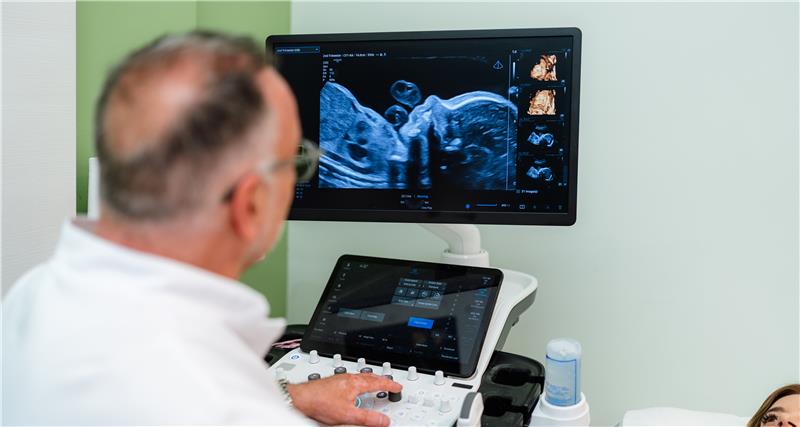
Tele-ultrasound allows a radiologist to remotely control a robotic arm equipped with a probe. This technology promises to revolutionise access to healthcare in areas affected by medical deserts. But can it compete with conventional ultrasound in terms of diagnostic quality and reliability? Do clinical data show similar performance? AdEchoTech’s MELODY solution, the world’s first certified industrial system, has been tested in more than 25 studies. Let’s take a look at the conclusions presented in two of them: Adams et al. (2016, Canada) and the thesis by Gambier Harold (2019, France). This article compares the performance of teleoperated ultrasound with standard ultrasound in various populations.
Ultrasound, an essential imaging technique with unequal access
Abdominal and renal ultrasound remains the first-line examination for investigating digestive and urinary disorders in adults and children. However, access to it is problematic in many contexts. For example, in nursing homes and rehabilitation centres, elderly patients are frail and often unable to be transported. In peripheral hospitals and rural areas, ultrasound expertise is also lacking due to the shortage of specialists characteristic of medical deserts. The result: poor care, delayed diagnoses, costly travel, and even a refusal to seek treatment.
Robotic tele-ultrasound appears to be an appropriate response to these challenges. The MELODY solution, developed by AdEchoTech, is based on an ultra-precise robotic arm that replicates the movements of a radiologist. The system is coupled with a standard ultrasound scanner and connected via secure videoconferencing. With the help of a local assistant to manage the pressure and position of the robot, MELODY democratises ultrasound expertise.
The major challenge of remote-controlled ultrasound: performance and diagnostic reliability at a distance
Remote-controlled ultrasound must meet strict requirements in order to be clinically viable. It must:
- offer sufficient image quality to make a reliable diagnosis, even in elderly or uncooperative patients;
- preserve the comfort of frail individuals, often from nursing homes or rehabilitation centres.
In elderly patients, cooperation is reduced, particularly due to difficult breath-holding or impaired comprehension. In addition, in overweight patients, the acoustic windows are narrow. The MELODY system overcomes these obstacles. It accurately reproduces the movements of an experienced hand thanks to its robotic kinematics. All ultrasound settings are controlled remotely from the expert station.
Two studies, Adams et al. (2016, Canada) and the thesis by Gambier Harold (2019, France), confirm this technical reliability.
Tele-robotic ultrasound: reproducible clinical results
The study by Adams et al., conducted in Canada in 2016, involved 18 adults attending routine ultrasound scans. Each patient underwent a conventional examination, immediately followed by a tele-operated examination. The expert worked remotely from the examination site, assisted by a local assistant, demonstrating the feasibility of tele-ultrasound in a real-world setting.
According to the results, 92% of organs visualised using conventional ultrasound are also visualised using tele-ultrasound with sufficient quality, but also:
- 5 pathological lesions are detected by both modalities;
- some lesions were only detected by one or the other modality, illustrating the operator-dependent variability inherent in ultrasound.
In terms of organs and time:
- measurements of the liver, spleen and proximal aortic diameter were statistically equivalent between the two techniques;
- the examination time decreased from 39.9 minutes to 30 minutes with experience, a 21% reduction.
Finally, patients expressed a unanimous opinion: 100% would agree to repeat the teleoperated examination.
99% of examinations useful: tele-ultrasound is becoming essential for frail elderly patients
Gambier Harold’s thesis (2019) included 124 elderly and frail patients: two-thirds from nursing homes/rehabilitation centres and one-third hospitalised in Belle-Ile-en-Mer, with 63% of women over the age of 75. The study compared two distinct sites: one novice, in Tours, with six different operators, and the other expert in Belle-Ile-en-Mer, where more than 600 examinations had already been performed last year. The results were exceptional:
- 99% were found to contribute to the medical management of patients;
- 90% enabled a clear diagnosis to be made;
- 75% were sufficient as a single examination;
- standard ultrasound seemed necessary in only 6% of cases, and only among novices at the beginning of their experience.
The image quality was also impressive. It was rated satisfactory or very good in 90% of cases. Even when patients were uncooperative, 95% of the images remained perfectly usable.
Abdominal-pelvic tele-ultrasound: a reliable solution when conventional ultrasound is not available
Abdominal and pelvic tele-ultrasound is a relevant solution when access to conventional ultrasound expertise is limited in facilities located far from specialist centres. It is performed remotely by a radiologist with the support of a technician present with the patient and provides clinically useful images and reliable diagnostic guidance. It offers:
- Excellent satisfaction: 8.4/10 for patients, 7.9/10 for technicians and 7.4/10 for radiologists.
- 22.5% of lesions were detected solely by tele-ultrasound.
- Good to excellent visualisation for 90% of organs (gallbladder, spleen and aorta)
- A correlation of kidney/spleen measurements between the two modalities.
- The time was realistic: 27 minutes, equivalent to complex examinations, compared to 12.7 minutes for standard examinations.
Furthermore, even in patients with a high BMI, tele-ultrasound provided reliable clinical guidance for the liver, gallbladder and spleen.
Unanimously positive feedback on patient tolerance, operator comfort and examination time
Patients overwhelmingly favour tele-ultrasound. In fact, 100% agree to repeat the examination, feeling less abdominal pressure when it is performed by the local assistant. In addition, videoconferencing maintains a reassuring human contact. Medical teams are also won over: the examination is less physically tiring, with no prolonged standing or repetitive movements.
In terms of examination time, it should be noted that a conventional ultrasound scan generally lasts 15 to 20 minutes. The teleoperated solution takes 25 to 40 minutes for novices. But experience radically changes the situation: for experts, the time stabilises between 15 and 30 minutes, which is equivalent to the standard. In addition, the overall gain is obvious, avoiding one to two hours of transport per patient.
Telemedicine ultrasound with MELODY: successful field deployment and a security framework that complies with regulatory requirements
The MELODY robot adapts perfectly to local conditions. Initial training is short and followed by on-site support to help users get started. This allows assistants to quickly learn how to communicate and position the robot. In addition, special cushions limit pressure on patients in nursing homes, in an environment optimised for calm. The system also tolerates excess weight and manages the reduced cooperation inherent in old age.
MELODY has been CE-MDR certified since 2023. This certification attests to the device’s compliance with European requirements in terms of:
- safety;
- clinical performance;
- traceability;
- cybersecurity.
AdEchoTech’s MELODY solution demonstrates diagnostic performance comparable to conventional ultrasound. Robotic tele-ultrasound is ideal for nursing homes, rehabilitation centres, remote islands and local hospitals. It avoids unnecessary transfers and speeds up critical clinical decisions by maintaining a high level of centralised expertise.
Key takeaways
- MELODY tele-ultrasound offers diagnostic performance comparable to conventional ultrasound.
- Extremely useful in nursing homes and rehabilitation centres, it enables reliable diagnosis without the need to transport the patient.
- Comfort is improved, fatigue is reduced for staff, and acceptance is almost unanimous.
- The time required is close to the standard for experienced users, with an overall gain due to the absence of transport.
- Rapid training, adaptation to the field, and CE-MDR marking guarantee the safety and reliability of the MELODY system.
👉 AdEchoTech will support you throughout this deployment. Contact us today.
Sources :
Adams, Scott J et al. “Initial Experience Using a Telerobotic Ultrasound System for Adult Abdominal Sonography.” Canadian Association of Radiologists journal vol. 68,3 (2017): 308-314. doi:10.1016/j.carj.2016.08.002
Gambier H. Télé-échographie : faisabilité et aide au diagnostic. Étude prospective sur 100 patients. Doctoral thesis in medicine. University of Tours, Faculty of Medicine; 2019.