

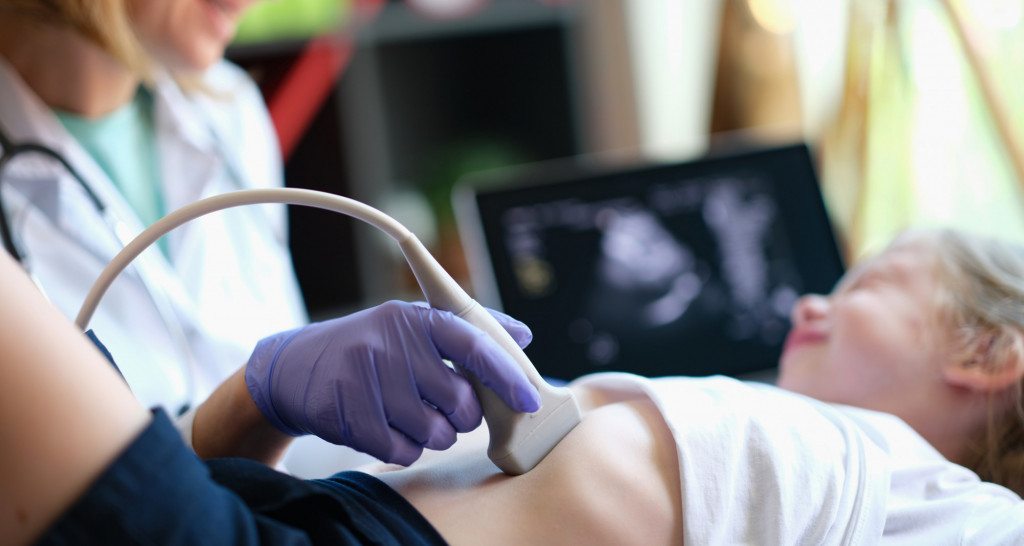
Ultrasound is the first-line imaging test in paediatrics, particularly for examining the abdomen, and X-rays should be limited as much as possible. It is non-invasive and painless, and allows real-time exploration of most pathological conditions in children and infants. However, access to this imaging remains complicated, as it requires specific ultrasound expertise, which is often lacking or difficult to obtain in peripheral hospitals or areas with low medical coverage, particularly in emergencies. Telerobotic ultrasound thus appears to be a solution to the lack of local expertise. The Melody solution, developed by AdEchoTech, is currently the first robotic technology in the world to have demonstrated its effectiveness in several paediatric specialities. It thus highlights the value of the Melody robot in improving access to care for young patients.
Melody robotic ultrasound has been successfully evaluated in several published clinical studies, including a bicentric paediatric study (Delestrain et al., 2023) and a study conducted in a prenatal setting (Adams et al., 2018).
The major challenge of remote robotic ultrasound in children: ensuring reliability
Ultrasound examinations in children require specific conditions. Indeed, patient cooperation and the anatomical areas accessible to ultrasound (acoustic windows) are often unique. Taking into account their constantly evolving morphology, remote-controlled imaging technology used in paediatrics must:
- provide sufficient image quality to make a reliable diagnosis;
- ensure the child’s comfort and safety.
The diagnostic reliability of remote robotic ultrasound in children therefore depends on its ability to accurately reproduce the practitioner’s hand movements and transmit ultrasound signals without degradation in real time.
The Melody robot, developed by AdEchoTech, was designed to meet these requirements. It works by faithfully reproducing the doctor’s movements remotely via a robotic arm located at the patient’s site. This technology has been evaluated in several clinical trials, including a bicentre paediatric study (Delestrain et al., 2023) and a study conducted in a prenatal setting (Adams et al., 2018).
👉 Would you like to learn more about the Melody device? Discover how tele-echography is a remote imaging solution that addresses the issue of medical desertification.
Telerobotic ultrasound in paediatrics: encouraging clinical results
To determine the reliability of Melody technology, the robot’s performance was compared to that of conventional ultrasound in children aged 1 to 10 years (Delestrain et al., 2023). The young patients underwent two examinations: one remotely operated using the Melody robotic system, and the other immediately afterwards, on site, by a second operator working blind. The aim was to assess whether the diagnoses, image quality and patient tolerance of the procedure were consistent.
The results show that:
- the images obtained remotely are as reliable as those taken in person;
- the organs studied (abdomen, heart, lungs) are of equivalent quality with no loss of diagnostic accuracy or interpretation errors;
- the abnormalities identified by Melody correspond exactly to those detected during a conventional consultation.
In terms of tolerance among young patients, feedback has been equally positive.
- 45% of parents felt that the robotic examination with Melody exerted less pressure than a traditional ultrasound scan.
- No incidents or adverse effects were detected.
- Only two children reported moderate discomfort with no clinical consequences.
The examination time was slightly longer: 26 minutes compared to 14 minutes for a conventional ultrasound scan. This difference is thought to be mainly due to the learning phase and communication between the remote radiologist and the local operator. However, this additional time did not affect the accuracy of the diagnosis.
These observations demonstrate the reliability and clinical performance of remote ultrasound in paediatrics. They also confirm its tolerability in children.
Confirmed diagnostic accuracy in pregnant women for remote-controlled ultrasound
Before being evaluated in children, Melody technology had already proven itself in prenatal imaging. Obstetric ultrasound remains a major public health issue, particularly in regions where imaging facilities are scarce. Patients may have to travel long distances to undergo an ultrasound scan, which can lead to delays in treatment or, in some cases, to prenatal imaging being abandoned altogether.
In this context, Melody technology was tested in pregnant women for prenatal examinations between 15 and 36 weeks of pregnancy. The aim of this Canadian study was to compare the conventional approach with the remote robotic method (Adams et al., 2018). The conclusions were particularly positive.
The main measurements of the foetus (head width, head circumference, amount of amniotic fluid) were virtually identical, with clinically negligible differences.
The doctor’s movements were reproduced accurately.
The quality of the transmitted image enabled a reproducible and reliable diagnosis.
The experience was also very well received by patients.
- 97% said they would be willing to have another remote consultation.
- 86% found the visual and vocal presence of the practitioner throughout the examination reassuring.
- Nearly half reported feeling more comfortable with a procedure they perceived as gentler than a traditional examination.
For operators, the use of Melody reduced physical fatigue associated with repetitive movements.
These results demonstrate that robotic tele-ultrasound offers reliable diagnosis and builds trust between doctors and patients. They also support paediatric observations by ensuring comprehensive remote medical monitoring.
Tele-ultrasound: reliable technology suited to paediatric practice
Clinical practice tailored to young people
The French study (Delestrain et al., 2023) documented the implementation of remote-controlled ultrasound in paediatrics. The Melody system was particularly well suited to young patients thanks to:
- a lighter robotic arm and the addition of cushions to limit pressure on the chest or abdomen;
- training for assistants in communicating with children and parents;
- a colourful and reassuring examination environment;
- maintained audio-video contact between the remote doctor, the patient and the accompanying adult.
This approach put the child at ease and facilitated their cooperation throughout the consultation. These practical elements thus complement the scientific validation. They confirm the feasibility of robotic tele-echography in a real paediatric context.
Promising clinical prospects for teleoperated ultrasound
Current data indicate that robotic tele-echography could significantly expand the field of paediatric imaging. Its use is particularly relevant in:
- medical deserts, establishments with limited access to expertise (peripheral hospitals, rural areas), where it avoids transfers and speeds up clinical decision-making;
- regular monitoring of certain conditions to ensure continuity of interpretation by specialists.
However, the authors of the Delestrain et al. study emphasise the need for specific training for assistants responsible for positioning the robot.
Recognised reliability within a secure regulatory framework
The diagnostic reliability of a medical device cannot be separated from its regulatory compliance. The Melody system obtained CE marking in accordance with the new European MDR regulation in 2023. This certifies its safety and performance quality.
Key takeaways
- AdEchoTech’s Melody robotic tele-ultrasound is the first solution in the world to have demonstrated its diagnostic reliability in several paediatric specialities.
- The Delestrain et al. (2023) study confirmed image quality and diagnostic accuracy comparable to those of conventional ultrasound in children.
- The Adams et al. (2018) study showed excellent concordance between prenatal measurements obtained using tele-operated and conventional ultrasound.
- This research validates the credibility of Melody robotic tele-echography.
- Melody paves the way for wider access to high-quality imaging, particularly in local facilities or areas with low medical coverage.
- The solution has CE-MDR certification, a guarantee of safety and performance for healthcare professionals.
Sources :
Delestrain C, Jung C, Malterre A, et al. Comparison of telerobotic and conventional ultrasonography in children: a crossover bicentric pilot study. Transl Pediatr. 2023;12(5):816-826. doi:10.21037/tp-22-569
Adams SJ, Burbridge BE, Badea A, et al. A Crossover Comparison of Standard and Telerobotic Approaches to Prenatal Sonography. J Ultrasound Med. 2018;37(11):2603-2612. doi:10.1002/jum.14619