

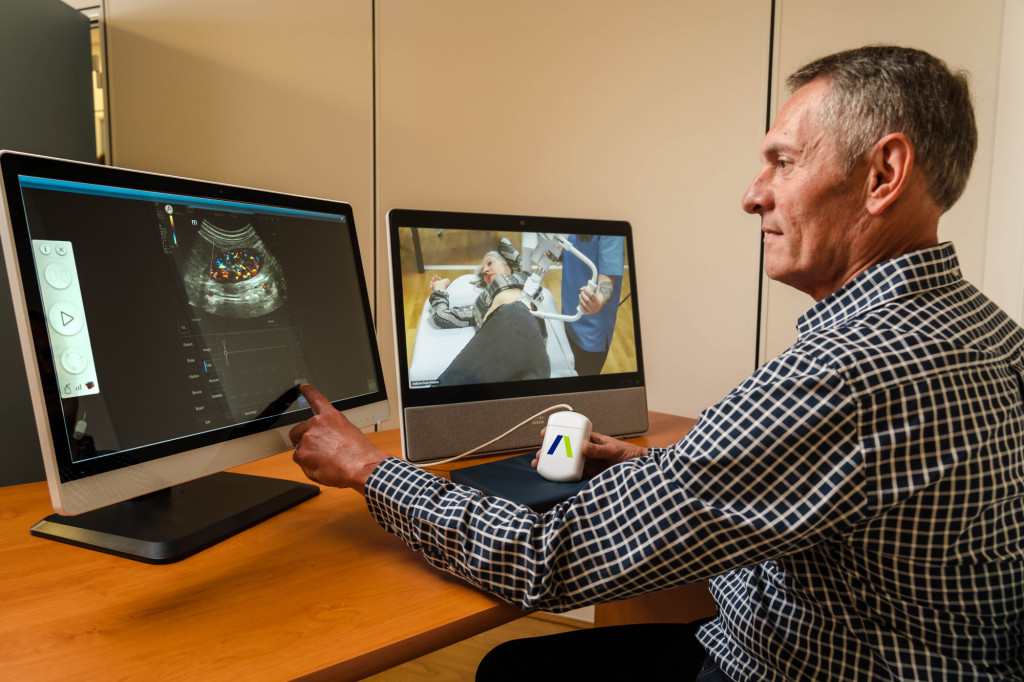
The CESARS centre at CNES recently validated a major advance in connected health: satellite tele-ultrasound. This unprecedented experiment is based on MELODY technology, developed by AdEchoTech. It demonstrates that ultrasound scans can now be performed in real time and remotely, even in areas without a reliable terrestrial network. The results show clinical quality equivalent to that of an in-person examination. This innovation illustrates French expertise in e-health and the complementarity between space technologies and public health needs. In this article, discover how the collaboration between CNES and AdEchoTech is ushering in a new era for remote medical imaging.
The MELODY solution, an innovation born in France
MELODY is a robotic tele-ultrasound solution designed and developed by AdEchoTech. It allows an expert physician, who views ultrasound images in real time, to remotely control an ultrasound probe. The operator, located several hundred or thousand kilometres away, controls the pressure and position of the robotic arm installed near the patient.
The fluidity of the experience is based on high-performance two-way transmission: voice, image and motor commands are transmitted without any perceptible latency. This guarantees the same precision of movement as in a face-to-face procedure. The MELODY device has already proven itself in numerous situations. The experiment conducted at the CESARS centre at CNES goes even further. It proves the feasibility of this approach thanks to satellite connectivity.
CNES and CESARS: catalysts for innovation in space health
The CNES Centre for the Evaluation of Space Systems for Improving Health Response (CESARS) is a test bench that is unique in the world. It can be used to simulate remote medical situations in constrained or isolated environments. It can also be used to evaluate the performance of e-health solutions based on space technologies. CNES provided the ideal setting for testing the compatibility of tele-ultrasound with low-orbit satellite networks.
This partnership embodies a shared vision of CNES and AdEchoTech: space at the service of humanity. CNES thus confirms its involvement in the societal challenges of space and its role as an accelerator of innovation in the field of connected health.
A successful test thanks to low-orbit constellations
The experiment conducted at CESARS was based on two low-orbit constellations, Eutelsat OneWeb and Starlink. These next-generation infrastructures offer very low latency and stable bandwidth. These are two essential prerequisites for demanding medical applications. The results obtained are particularly promising.
- The latency is compatible with precise medical procedures: the doctor’s hand movements are instantly translated into the movements of the robotic arm.
- The data rate is moderate, with tests confirming that a bandwidth of 2 Mbit/s is sufficient to guarantee video quality and command synchronisation.
- Security and reliability: transmission is encrypted and stable, ensuring the confidentiality of medical data and signal integrity.
This performance shows that low-orbit satellite connectivity now offers a level of service comparable to that of terrestrial networks. It also remains available in areas without traditional network infrastructure.
Satellite tele-ultrasound: multiple applications, from space to remote areas
The benefits of satellite tele-ultrasound thus extend beyond the experimental realm. This technology opens up new possibilities for remote medical care in extreme or isolated conditions, such as:
- underserved areas and rural areas;
- overseas territories;
- humanitarian missions and emergency operations;
- extreme environments.
Satellite-based tele-ultrasound offers an effective and secure alternative wherever distance, topography or lack of network coverage constitute an obstacle to access to healthcare.
Satellite tele-ultrasound: a response to major public health challenges
The success of this test illustrates the societal impact of MELODY technology. This solution offers a response to medical deserts and helps reduce inequalities in access to healthcare. The challenge goes beyond technical prowess. It is about offering the same opportunities for diagnosis and medical monitoring everywhere on the planet, from large cities to the most isolated villages.
The implications are also significant for healthcare systems, with:
- a reduction in patient transfers;
- optimisation of hospital human resources;
- the pooling of expertise;
- a reduction in the carbon footprint associated with medical travel.
AdEchoTech and CNES: a partnership focused on the future
The collaboration between AdEchoTech and CNES, through its CESARS centre, marks an important step in demonstrating the potential of satellite tele-ultrasound. Trials conducted with MELODY technology have confirmed the clinical quality and reliability of the device, paving the way for new uses in the field.
Beyond experiments conducted in rural or isolated areas, AdEchoTech now plans to extend this innovation to specific environments, particularly prisons. The aim is to provide access to high-quality medical imaging without moving patients, while complying with the security and confidentiality requirements specific to this context.
By supporting this work within CESARS, CNES is demonstrating the French space industry’s ability to respond to concrete societal challenges. This joint initiative shows how space technology can become a lever for medical innovation and help reduce inequalities in access to healthcare, both in France and internationally.
The MELODY project demonstrates that space technology is becoming a lever for equity in access to healthcare by combining satellite connectivity, medical robotics and clinical expertise. Thanks to the low latency and wide coverage of low-orbit constellations, millions of people could eventually benefit from medical expertise without geographical constraints. This is a new step towards inclusive, sustainable e-health driven by French innovation.
Source :
CNES – CESARS Centre of Expertise, ‘La télé-échographie par satellite testée avec succès‘,published on 16 December 2025.