

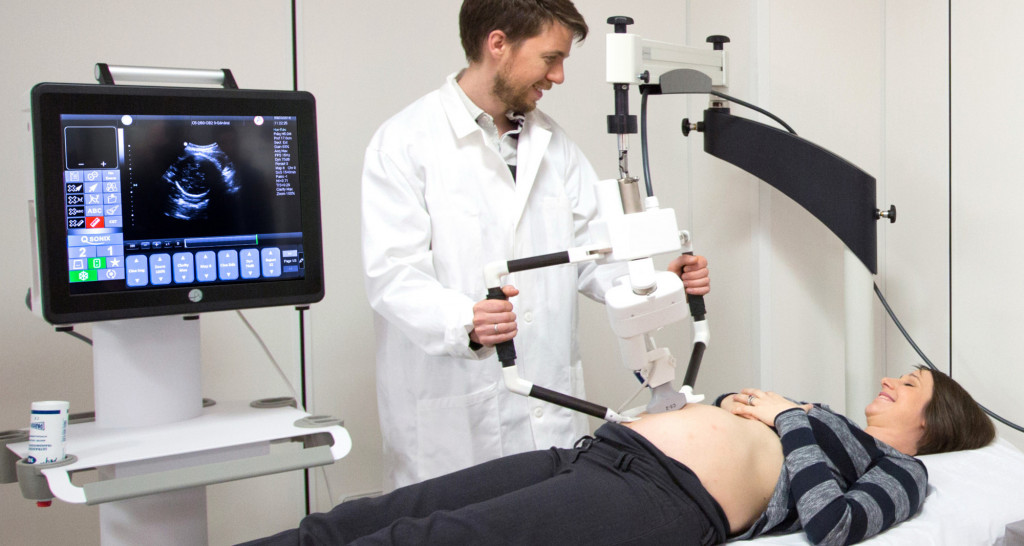
Obstetric ultrasound plays a central role in pregnancy monitoring, from confirmation of pregnancy to assessment of fetal growth and anatomy. However, in many rural areas or areas with a shortage of specialists, access to these examinations remains uneven. This disparity forces pregnant women to travel long distances to obtain high-quality imaging. Remote ultrasound, on the other hand, allows an expert sonographer to control a probe remotely using a robotic arm and a secure connection. In this article, discover how robotic ultrasound applied to pregnancy monitoring makes medical expertise accessible for prenatal care.
What is robotic ultrasound used for pregnancy monitoring?
Remote-controlled ultrasound relies on an interface between a robotic arm positioned on the patient and a remote control console operated by a radiologist. The robot reproduces the professional’s movements on the pregnant woman’s abdomen in real time.
The MELODY robotic remote ultrasound system consists of several components:
- a robotic arm;
- an ultrasound scanner;
- a secure audio-video link;
- remote control software.
The expert maintains control over important settings (gain, depth, focus, choice of cutting planes) by communicating directly with the patient and the local team.
In an obstetric context, this approach allows the following to be performed remotely:
- limited viability, dating, and fetal presentation examinations;
- biometric measurements (head circumference, biparietal diameter, abdominal circumference, femur length, amniotic fluid);
- a large part of the second trimester morphological examination, depending on clinical and technical conditions.
The benefits of robotic ultrasound for pregnant patients
One of the major benefits of robotic ultrasound is that it reduces the need to travel to referral centers, which are sometimes located hundreds of miles away. In some regions, patients have to travel very long distances to see an ultrasound technician or visit a prenatal diagnostic center. This causes fatigue, costs money, and delays treatment.
Robotic tele-ultrasound also facilitates more frequent monitoring for high-risk pregnancies (hypertension, gestational diabetes, obstetric history, etc.) that require close follow-up.
Several benefits stand out, for example:
- rapid access to specialist advice, even from a peripheral healthcare center;
- maintenance of the recommended ultrasound schedule (dating, morphological ultrasound, targeted checks) despite geographical or health constraints;
- reduced risk of interrupted follow-up for vulnerable or isolated patients.
Clinical studies also show a high level of patient satisfaction. The vast majority (97%) say they would be willing to have another tele-robotic ultrasound during a future pregnancy. They highlight the quality of remote support, the feeling of security, and the comfort of being monitored at their usual facility (Adams et al., 2018).
Telemedicine ultrasound: balancing image quality and diagnostic performance
Robotic ultrasound must offer image quality and reliable measurements comparable to a standard examination in order to be useful in pregnancy monitoring. Studies conducted with the MELODY system show excellent correlation between biometric measurements taken in person and those obtained remotely.
In addition, the concordance between robotic and conventional measurements is considered excellent for most parameters, with small clinically acceptable differences. This allows robotic tele-ultrasound to be used to:
- confirm fetal viability and date the pregnancy;
- monitor fetal growth over time;
- verify placental location and amniotic fluid volume.
As for the complete morphological examination in the second trimester, the results depend more on factors such as fetal position, maternal body mass index, or network connection quality. Nevertheless, fetal structures are largely visualized correctly, which allows many clinical questions to be answered without systematically referring the patient to a specialist center.
Robotic ultrasound, an asset for remote areas and crisis situations
Robotic tele-ultrasound is particularly well suited to the needs of isolated areas, medical deserts, and regions where ultrasound services are intermittent. By installing a system such as MELODY, it becomes possible to organize scheduled ultrasound sessions with a remote expert.
The experience of deploying robotic ultrasound in a pandemic context (Adams et al., 2022) also illustrates its value in health crises. During certain episodes of COVID-19, travel by patients and professionals to remote communities had to be limited to reduce the risk of transmission. In this situation, robotic tele-ultrasound made it possible to maintain high-quality obstetric care.
This technology also helps reduce inequalities in access to prenatal screening, for example for indigenous or disadvantaged populations, who often experience more obstetric complications.
👉 Tele-ultrasound isn’t just useful for monitoring pregnancies. Discover how it’s proving effective in pediatrics.
The role of AdEchoTech and the MELODY solution
AdEchoTech is one of the pioneers in robotic tele-ultrasound with its MELODY system, which has already been evaluated in several clinical studies. The features that set MELODY apart in pregnancy monitoring are:
- precise reproduction of the operator’s hand movements for accurate acquisition of cross-sectional images;
- remote control of ultrasound parameters for live image optimization;
- a smooth audio-video interface for dialogue with the patient and the local team;
- a quick learning curve for field teams responsible for positioning the robot and assisting the patient.
Robotic ultrasound reduces travel, improves equity of access to prenatal screening, and maintains diagnostic quality comparable to standard examinations. Solutions such as MELODY offer a response to the current challenges facing obstetrics. Robotic tele-ultrasound thus represents an opportunity for healthcare facilities and professionals to expand the range of care offered and ensure safe pregnancy monitoring.
👉Discover how the deployment of the MELODY solution at the CHIRC in Redon is an example of how robotic ultrasound reduces inequalities in access to imaging care.
Sources :
Adams, Scott J et al. “A Crossover Comparison of Standard and Telerobotic Approaches to Prenatal Sonography.” Journal of ultrasound in medicine : official journal of the American Institute of Ultrasound in Medicine vol. 37,11 (2018): 2603-2612. doi:10.1002/jum.14619
Adams, Scott J et al. “Telerobotic ultrasound to provide obstetrical ultrasound services remotely during the COVID-19 pandemic.” Journal of telemedicine and telecare vol. 28,8 (2022): 568-576. doi:10.1177/1357633X20965422