

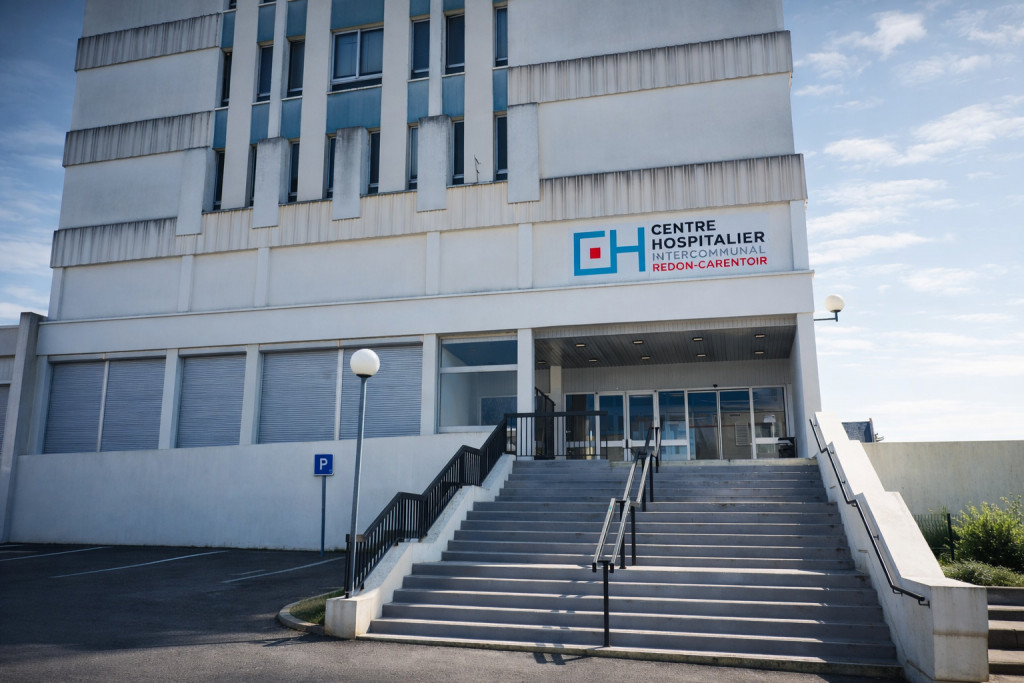
Since May 2025, the Redon-Carentoir Intercommunal Hospital Centre (CHIRC) in Ille-et-Vilaine has been equipped with MELODY, the medically validated teleoperated ultrasound robot developed by AdEchoTech. This innovation, remotely controlled by a radiologist, helps to address the national shortage of radiologists. It also streamlines care pathways and modernises access to imaging. Discover how MELODY, the tele-ultrasound robot installed at the CHIRC in Redon, enables high-precision remote examinations to be carried out.
Why did the Redon CHIRC opt for tele-echography?
Like many peripheral hospitals, the CHIRC faces difficulties in recruiting radiologists and ensuring their regular presence. However, ultrasound is one of the most requested examinations, particularly for abdominal pain, paediatric conditions and vascular assessments. Teams must therefore resort to CT scans, even though this technique involves exposure to ionising radiation, which is best avoided when an ultrasound scan is sufficient, particularly in children. Sometimes, patients are transferred to other facilities when the examination cannot be performed on site. The result: time-consuming, cumbersome and costly procedures for the requesting facility.
For these reasons, the hospital has chosen to outsource radiology expertise without depriving patients of local examinations. With MELODY technology and tele-ultrasound, the CHIRC in Redon is speeding up treatment and streamlining care pathways.
👉This need for access to local imaging responds to the challenges posed by medical deserts.
How does MELODY work at the CHIRC in Redon?
Tele-echography relies on a two-person operation:
- remotely, the radiologist manipulates a twin probe that faithfully reproduces their movements;
- on site, a technician or nurse trained in tele-echography positions the robot and assists the patient during the examination.
This organisation was set up thanks to close collaboration between the imaging department, the teleradiology company (TIM), medical teams and paramedical managers. Staff were able to integrate MELODY into their daily practice after initial training and support in getting started. Two radiographers (MERM) now serve as points of contact and play a central role in coordinating between the local team and partner radiologists. The protocols established now make it possible to perform abdominal and pelvic ultrasounds and some thyroid ultrasounds.
The impact of remote tele-echography on the continuity of care
More than 353 patients have already benefited from remote ultrasound scans at the CHIRC since MELODY was installed. Numerous transfers to other hospitals for ultrasound scans have been avoided, reducing waiting times and limiting travel, particularly for elderly or dependent patients.
Robotic remote ultrasound also avoids the need for systematic heavy imaging, especially for children. This possibility plays an essential role in improving care pathways.
Furthermore, contrary to initial concerns, older patients welcome the MELODY examination. The presence of a professional on site and the quality of the images produced help to reassure them.
👉MELODY has unique technology that is now deployed in more than 70 establishments worldwide. It has improved the quality of care for more than 300,000 patients.
Remote-controlled ultrasound, a positive experience for professionals
The integration of MELODY has also transformed the daily lives of the teams. Technicians are now responsible for preparing examinations and coordinating with radiologists. This new responsibility diversifies their activities and strengthens interprofessional ties.
The CHIRC can also absorb part of the demand without relying entirely on external practitioners travelling to the hospital, thanks to tele-ultrasound. This improves the continuity of imaging services.
The CHIRC was already using remote interpretation of scans. The arrival of MELODY is therefore part of an overall strategy to modernise imaging, in which telemedicine is becoming an essential element.
Telemedicine ultrasound at the CHIRC in Redon, a regional organisation undergoing restructuring
Redon’s project was inspired by other facilities in Brittany, such as the Châteaubriant-Nozay-Pouancé hospital. It was supported by regional initiatives, notably with the backing of the Brittany Regional Health Agency (ARS Bretagne). This regional dynamic shows that tele-echography is becoming a key issue in healthcare planning in areas where medical resources are limited.
At the CHIRC, the objectives are now to:
- increase the number of trained professionals;
- maintain regular practice to retain proficiency with the tool;
- enable technicians who wish to do so to obtain a university diploma in ultrasound scanning in order to perform certain examinations within a protocolised framework, under medical supervision;
- become a pilot site capable of supporting other local establishments.
The aim of this skills development is to ensure continuity of service during peak periods or times of pressure on human resources.
The experiment conducted at the CHIRC shows that tele-ultrasound can significantly transform the organisation of imaging care in underserved areas. MELODY is a tool that is fully integrated into the imaging department’s operations. The CHIRC has succeeded in reconciling proximity and modernisation of care by enabling expert examinations to be carried out without the physical presence of a radiologist. The Redon hospital has thus become an example of what tele-operated ultrasound can bring to the healthcare system: fluidity, equity and a response to growing imaging needs.
Sources :
mySIH Magazine, No. 78, October 2025. Feature article: “Au CHIRC de Redon, Melody révolutionne l’accès à l’échographie”